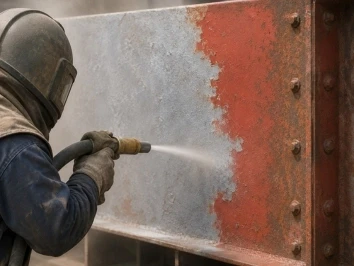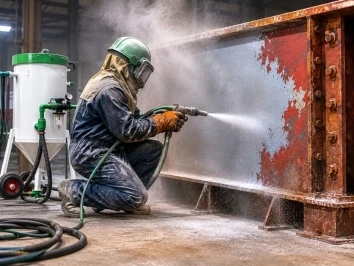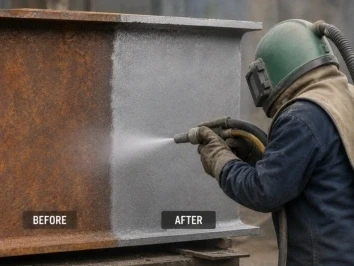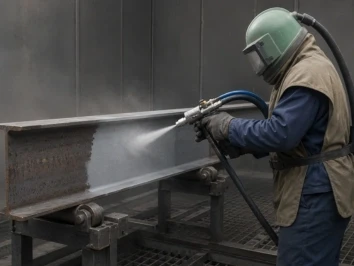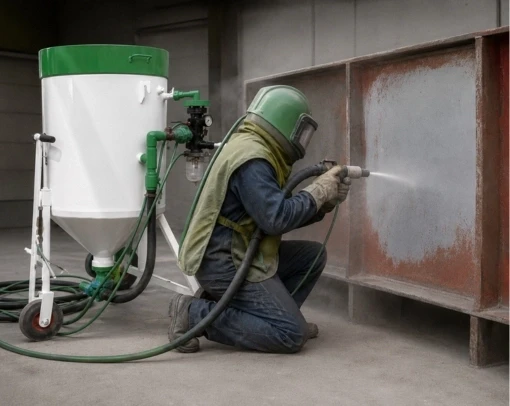
Professional media blasting paint removal uses controlled non-metallic or abrasive garnet sand media to lift failed primers, intermediates, and topcoats while holding anchor profile inside the range your next coating system requires. The objective is not simply a visibly lighter surface; it is a documented handoff that painters can prime without holidays, intercoat contamination, or flash rust from sitting bare steel too long.
Media Blasting Paint Removal for Industrial and Architectural Metal
Scopes should name substrate alloy, existing coating chemistry, visual cleanliness class, profile limits, masked features, and how primer timing aligns with dew point. When those items live only in verbal site meetings, turnover arguments appear at flange toes and stiffener corners where access is hardest.
How air blaster paint removal differs from casual pressure washing
Programs described as air blaster paint removal rely on compressed air and sand blasting nozzles to deliver kinetic energy through media, not on water pressure alone. That distinction matters on multi-layer industrial stacks where films are tightly adhered. Pressure washing may soften chalky exteriors, but rarely delivers the anchor texture that high-build epoxies or zinc-rich systems expect after stripping.
Compressor CFM, air quality, and line losses
Long sand blasting hose runs, undersized couplings, and moisture in the airlines starve nozzles and accelerate wear. Dryers, oil separators, and realistic CFM budgets belong in the method statement so shift production rates stay believable through heat waves and night drops in temperature.
Media families and paint chemistry interactions
Epoxies, urethanes, alkyds, and powder coats release at different rates under the same nozzle setup. Angular mineral cuts faster on thick skids but may risk thin sheet; garnet or recyclable blends often balance strip speed with finish on mixed fabrications. Sponge or plastic abrasive media enter the conversation when substrate sensitivity or neighbor dust limits dominate the risk register.
Test patches and witness coupons
Hidden elevations and sacrificial coupons prove strip rate and profile before full production. Photograph each approved patch so night crews and substitute blasters can reproduce the same pass speed, angle, and stand-off without improvising new parameters mid-job.
Structural steel, tanks, and piping in turnarounds
Shutdown paint removal sand blaster on vessels, pipe racks, and skids usually runs beside live lines or occupied aisles. Barricade drawings, gas monitoring for confined volumes, and instrument covers should be attached to the permit pack before blasting starts. Daily square-meter logs tied to accessible area keep project controls honest about whether the critical path is drifting.
Tie-ins after weld repair
Fresh welds need feathering into sound coating without leaving holidays at toes. Mark blast boundaries on isometrics so painters know where stripe coats begin. Matching profile across parent metal and repair zones prevents telegraphing through high-build systems at final inspection.
Shop booths versus field containment
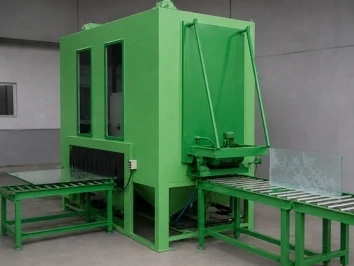
Yard booths control rebound, lighting, and recovery for trailerable gates, beams, and OEM frames. Field work on installed steel adds wind, ground moisture, and shared crane hooks. Quotes must state which environment applies so lift tickets and painter crews sequence in the correct order.
Urban facades and neighbor-sensitive optics
Curtain walls, night-only windows, and sound limits may dictate softer schedules or vacuum-assist recovery heads. Pre-walks with facilities and community liaisons reduce stop-work surprises after high-visibility elevations are already open.
Regulated coatings, lead, and waste documentation
Older paint films may require sampling, worker protection tiers, containment, and drum manifests. Paint chips and spent abrasive media remain solid waste streams even when the process looks “dry.” End-of-shift cleanup photos support audits and neighbor relations when dust is politically visible.
Handoff to primers, linings, and metallizing
Bare metal clocks start when dust lifts. Agree maximum hold time, humidity limits, dew-point monitoring, and whether inhibitors are permitted before stripe coating welds. When priming cannot follow immediately, write holdback rules and re-blast touch criteria so arguments do not appear at QC closeout.
Soluble salts and coastal exposure
Salt contamination under old paint may require washing or salt tests after strip. Coastal humidity compresses primer windows sequence shifts, so painters are staffed when blast crews call surfaces ready, not hours later after flash rust appears.
Automotive, restoration, and thin-gauge discipline
Chassis and undercarriages may tolerate more direct energy than outer skins or ornamental scrollwork. Smaller nozzles, lower pressure, and shorter dwell reduce warp risk. Log panel temperature on sunny days so crews do not chase strip speed at the expense of metal movement.
Masking, plugs, and assembly-sensitive zones
Threads, seal surfaces, and glass-adjacent edges need disciplined protection before the first pass. Photograph mask lines at handover so assembly teams know which features were intentionally left untouched versus areas still scheduled for mechanical touch-up.
OEM skids, power equipment, and rotating machinery
Paint removal on motor frames, compressor skids, and packaging lines must avoid embedding media in windings or grease passages. Method statements should list blower intakes to seal, coupling guards to bag, and vibration pads to shield. Dry film thickness maps from prior thermal spray coatings help predict where multiple passes will be needed without guessing on the first shift.
Re-blast touch rules after handling
Once stripped metal is handled for fit-up or transport, agree whether light sweep blasting is required before primer. Fingerprints, moisture, and shop dust can violate cleanliness if the rule is vague. Write the trigger in the turnover note so painters do not argue at the gun.
Media Blasting Paint Removal Comparing Methods
Chemical stripping, laser, and power tooling have niches, but wide-area industrial repaint programs usually return to the media blasting machine for a uniform profile. Understanding where alternatives stop saves paying twice on the same elevation when the coating vendor still demands measurable anchor texture on the data sheet.
Long-term performance after repaint
Stripping alone does not fix chronic moisture traps or design details that caused prior failures. Where peeling repeated on the same detail, pair removal with drainage, sealant, or ventilation improvements so the new coating system lasts beyond the first warranty period.
Commercial transparency procurement expects
Separate mobilization, labor shifts, media tons, disposal, equipment rental, and weather standby. Note whether power, compressed air, cranes, or scaffolding are owner-furnished. Change orders tied to drawing revisions keep multi-week paint stripping programs auditable for finance, procurement, and QA teams.
Waste, housekeeping, and digital turnover
Paint chips and spent media require drums, labels, and manifests where regulations apply. End-of-shift cleanup photos support internal audits and community optics when work faces public rights-of-way. Digital packs with photos of difficult geometry and signed inspection sheets reduce end-of-job debates about what “fully stripped” meant at mid-span.
Nozzle inventories and shift continuity
Sharp abrasive media accelerates tip wear; running out of matched nozzles mid-outage idles painters downstream. Pre-kit spare sets per rig and log consumption against planned tons, so procurement sees variance early instead of during the final push to turnover.
Search visibility without empty ranking promises
No ethical vendor guarantees automatic “top rank” in search engines. Sustainable visibility comes from helpful technical pages, fast mobile performance, accurate schema, and outcomes inspectors can verify on site. We focus on documented strip quality, agreed profile, and coating-ready handover, not repetitive keyword blocks.
Share substrate photos, coating layer history, approximate area, access method, environmental sensitivities, and target primer or lining system. Note shutdown dates and whether compressed air, lifts, or containment are owner-furnished so assumptions stay realistic for your entire paint stripping program.